Showing posts with label Our Environment. Show all posts

Tuesday, June 18, 2024

I may have found the reason why the current mayor and council remove so many trees - Dendrophobia

Palmetto Bay is not blessed with a Lorax council. Trees have been removed for horrible projects such as the SW 136Street multi-path.  Several trees in the way of her bridge project were actually smothered and then removed at Coral Reef Park – as well as failing to protect trees hundreds of years old throughout the village such as the huge Oak in the Morningside neighborhood (near Franjo Road) or all along the Old Cutler Road.  What is wrong with this tree hating council? 

Well, I have formed my own opinion: Dendrophobia - the fear of trees. Is this what drives the current mayor and the members of the village council to remove so many trees? 

I looked up this condition on the Cleveland Clinic website - https://my.clevelandclinic.org/health/diseases/22587-dendrophobia-fear-of-trees

Here is what I found on that website:

Dendrophobia is a fear of trees. People with this specific phobia feel anxious when they think about or see a tree. Many people with tree phobia have had negative experiences with trees. You can overcome a phobia of trees with exposure therapy, cognitive behavioral therapy, dialectical behavior therapy and other treatments.

Someone with dendrophobia may be afraid of:

Dangers hidden in trees, such as spiders, scorpions or snakes.
Encountering trees after dark.
Shadows made by trees.
Sounds of leaves rustling in the wind.
Tree branches or entire trees falling on them.
Tripping over tree roots. (a real concern presently at our parks - see photo right)
Walking or driving near or underneath trees.

Or maybe the mayor and council members suffered traumatic loses of their kites – to kite eating trees – when they were younger.

So perhaps there is an explanation for this tree hating behavior.

via GIPHY

Friday, June 14, 2024

Direct question - one tree saved - but I am seeking a statement from current Palmetto Bay officials: please state with certainty how many trees in Coral Reef Park will be chopped down for the new building

Are these trees in the way of "progress" - it took a viral online petition to save one tree, but which of these large, mature shade trees remain on the chopping block?

It is a fair question:  Madam Mayor, Mr. Manager, anyone from the council - please tell us in full and complete sentences how many trees and which ones are to be chopped down to make way for the new building?

The trees pictured above had red ribbons placed around them in April of 2024.
Will these trees also be protected or are they also on the chopping block?

Trees simply seem to "disappear" at Coral Reef Park!

These benches (below) were not installed in the direct sun light, but were originally shaded by a tree.  Where did that tree go? Look closely (click on and enlarge the photo - below right) you can find the stump giving evidence that there was once a tree shading those benches - and those who sat upon them. 

Past evidence. The haunting shadows of trees past (below center. Shade removed.  
Palmetto Bay officials have said nothing said about why these trees were hacked and removed.

EXACTLY HOW DOES THIS BUILDING FIT IN THE TREE CANOPIED AREA?

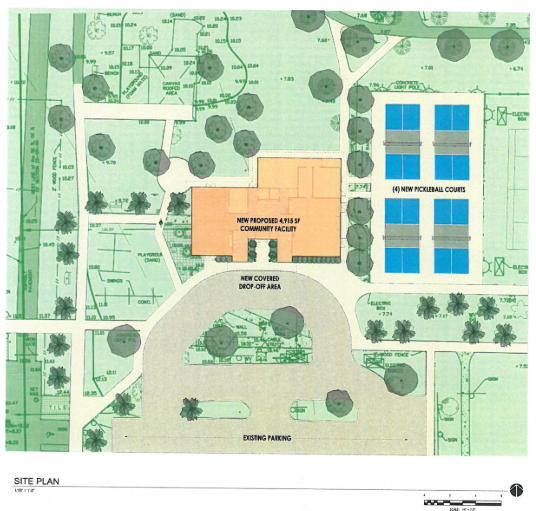
This new building is being shoehorned into one of the most dense areas of tree canopy.  There is a reason for the tree canopy - it is an area where our village children could play in the shade. Sure, the building will be air conditioned, but at what cost to our existing tree canopy?

Here is an official proposed site plan for the proposed building:

There is no overlay to demonstrate how this fits and which trees will be cleared for this project.  I am trying to do my best with the following photos of the current area:


Same photos above, but the other mature trees are circle in red (the saved tree is circled in white). Which trees survive and which ones are on the chopping block? As I like to say, these are all fair questions to ask and certainly the current mayor and council members should know, after all, haven't they all been following this project, giving direction to the manager and staff?

PRIOR RELATED POST - Here is an example of the true record of  the current mayor and council - the deforestation of  Coral Reef Park:

September 17, 2021 - A good (BAD) example of how Palmetto Bay officials are squandering our environmental assets. The affected trees were cut down & removed on 9-16-21 CLICK HERE


The Council never made a public statement about what was happening with these trees. Nope, not a peep - I'm sure their taxpayer funded PR department was of the opinion that it was better to say nothing than to admit their mistakes. But their actions did speak loudly as a tree removal crew quietly showed up on Thursday, September 16, to remove their mistakes. Two 40 plus year oaks were hacked down and removed from Coral Reef Park. What trees, you may ask? 


Above - other original oaks in the way of another vanity project of the current mayor and council.  The trees were there first - and any competent designer or any caring council could work around the trees. Who knows, perhaps they did not even know those trees were there until they broke ground.  The trees are first smothered, then ignored, the chopped down/removed and then the last evidence is removed.

This current mayor and council should resign from "Tree City USA" in shame. 

Sunday, April 10, 2022

April 10 - Celebrate Gopher Tortoise Day in Florida

Please do your part to keep our Palmetto Bay community a Gopher Tortoise friendly habitat. Palmetto Bay residents are fortunate have the opportunity to coexist with these torts in their natural habitat. There are several areas where you may encounter one while biking or out on your walk. It is up to us to protect their habitat.

To learn more about #GopherTortoiseDay and other ways to celebrate please visit: gophertortoisedayfl.com/

Included in the link above: 

Gopher tortoises are considered a keystone species because they dig burrows that provide shelter for 360 other species of wildlife, called “commensals.” These commensal species include the gopher frog, Florida mouse, eastern indigo snake, and hundreds of invertebrates like beetles and crickets. Without the gopher tortoise, many of these species would not exist.

You can help celebrate Florida’s only native tortoise by hosting an event in your community, asking your local City or County Commission to officially adopt April 10 as Gopher Tortoise Day, and by educating others on the importance of protecting gopher tortoises.

Use the menu above to access resources, including the resolution template, ideas for hosting your own event along with hands-on activities, and educational materials that can be printed and distributed to friends and neighbors in your community.

Learn more about the gopher tortoise by visiting:  MyFWC.com/GopherTortoise or GopherTortoiseCouncil.org.

Photo credit - MyFWC Florida Fish and Wildlife


Wednesday, January 26, 2022

An important environmental post worth repeating: What’s So Special about a 22 Acre Forest on Old Cutler Road, by Eduardo Varona, Guest Post (originally published October 18, 2018)

Is the environmental spirit dead with current elected officials? Why are they willing to spend hundreds of thousands of dollars in the future to "beautify" the median running within US1 (costs that they gladly assumed from FDOT), but not protect environmentally sensitive land? 

Various plans have been proposed. I proposed working with the Miami-Dade Environmentally Endangered Lands Program (EEL) several times. In fact, I worked to get these 22 acres placed on the "B" List for acquisition, but it requires that Palmetto Bay participate.  That would remove any threat of development both on that land or any transferrable rights being applied to adjoining land.  This land has been used as a political football for far too long and I am anxious to see a realistic plan to save this precious land. 

I rely upon experts. The 22 acres of the Palmetto Bay Village Center should be saved. Please see this guest post from 10/18/2018: What’s so special about a 22 acre forest on Old Cutler Rd? 

This forest is very special indeed. It is one of the last remaining remnants of the tropical rockland forest ecosystem that covered Miami-Dade County before we bulldozed 98% of it. Yes there is roughly only 2% left of this forest ecosystem left in all of South Florida. Most of this ecosystem existed almost exclusively in South Miami-Dade. And day by day we lose additional acreage to development and neglect.

Specifically, the 22 acres of the PBVC is a tropical rockland forest composed of rockland hammock and pine rockland. These two forest communities exist on the oolitic limestone ground in a fluid equilibrium with each other as the land can transition back and forth between the two distinct plant communities in a natural and controlled process influenced by fire, hydrology, and by man. The species diversity both plant and animal that this 22 acre forest harbors cannot be measured in dollars. It should not ever be measured in dollars. In fact some years ago, the 22 acres was nominated for inclusion into the County's Environmentally Endangered Lands (EEL) acquisition program. County biologists assessed the site in response and documented the important habitat values. As a result, the Board of County Commissioners added this site to the list of lands that EEL should purchase for management and protection. The land has remained on the list ever since awaiting funding for purchase.

Here is the complete guest post, originally published on October 18, 2018:

Thursday, October 18, 2018

What’s So Special about a 22 Acre Forest on Old Cutler Road, by Eduardo Varona, Guest Post

Many have questioned over the last decade what is the importance of 22 acres of privately owned native forest on the east side of Old Cutler Rd just north of SW 184 St in Palmetto Bay. Some have claimed and said it is a protected forest. The private owner at times has wanted to develop it and at times seems to want to protect it. Politicians have even fallen on their own swords actually proposing to develop it. At times part of the forest was even looked at for a fire station to serve the surrounding neighborhoods. 

In the last four years there has been a serious push to finally give steadfast lasting protections to this forest through a deal between the Village of Palmetto Bay and the private owner, the Palmetto Bay Village Center (PBVC). This agreement would involve a transfer of developmental rights from the 22 acres east to the parcels surrounding the PBVC. And Palmetto Bay would receive the 22 acre forest as the newest passive park in the “Village of Parks”.

So this begs the question, do the 22 acres of forest need protection? Is this privately owned forest currently protected from development now and in the future?

The answer to the second question is a very certain NO. The 22 acres have never been designated a Natural Forest Community (NFC) by the County and therefore are not protected whatsoever under County laws. To have been designated an NFC the private owner could have approached the county and asked for an ecological and biological assessment of the site. This has never happened. Had it happened, due to the relatively well maintained condition of the forest it would most likely have been designated an NFC. However, even if it had been designated an NFC it would only have protected a percentage of it from development, not all of it. 

What about a covenant that allegedly exists or existed that allegedly protects the forest. Well, depending on who you ask and on which side of the bed they woke, there is a covenant of sorts that is enforced by the Village. A covenant that the Village agrees is soon scheduled to expire.

But in actuality that covenant doesn’t protect the forest at all. It only protects the homes across from the forest along Old Cutler Rd by maintaining a “visual buffer” so that those homes can’t see the PBVC building. That is the extent of the covenant which is due to expire in 2019, if you ask the experts. Finally, is there interest by the private owner to develop the forest? Well why wouldn’t there be as it is prime real estate right on old Cutler Rd. If not protected, someday it will be developed.

Now let’s go back to the original question, the title of this writing. What’s so special about a 22 acre forest on Old Cutler Rd? This forest is very special indeed.  It is one of the last remaining remnants of the tropical rockland forest ecosystem that covered Miami-Dade County before we bulldozed 98% of it. Yes there is roughly only 2% left of this forest ecosystem left in all of South Florida. Most of this ecosystem existed almost exclusively in South Miami-Dade. And day by day we lose additional acreage to development and neglect. 

Specifically, the 22 acres of the PBVC is a tropical rockland forest composed of rockland hammock and pine rockland. These two forest communities exist on the oolitic limestone ground in a fluid equilibrium with each other as the land can transition back and forth between the two distinct plant communities in a natural and controlled process influenced by fire, hydrology, and by man. The species diversity both plant and animal that this 22 acre forest harbors cannot be measured in dollars. It should not ever be measured in dollars. In fact some years ago, the 22 acres was nominated for inclusion into the County's Environmentally Endangered Lands (EEL) acquisition program.  County biologists assessed the site in response and documented the important habitat values.  As a result, the Board of County Commissioners added this site to the list of lands that EEL should purchase for management and protection.  The land has remained on the list ever since awaiting funding for purchase.

Roughly half of the 22 acre forest is pine rockland with the rest consisting of an oak hammock also containing trees such as mastic and gumbo limbo. Yet it is a little known fact that pine rockland is a worldwide endangered ecosystem and plant community which only occurs in Cuba, Bahamas, and yes, Miami-Dade County, and only in South Dade. 

There is more that makes this 22 acre forest more unique than other similar parcels in South Dade. This forest is one of the last remnants of a vast coastal forest that existed in a long ecotone where the forest met the South Dade coastal wetlands and then beyond that Biscayne Bay. And there is even more that makes it so special. 


Few understand that all throughout the Miami coastal ridge where now lie the municipalities of Palmetto Bay, Cutler Bay, and Pinecrest there existed transverse glades, also known as finger glades. These transverse glades, traversed the coastal ridge as creeks and fresh water wetlands that in the wet season flowed with fresh water from the Everglades all the way to Biscayne Bay. One very large transverse glade occurred in the area known as Bel Aire in Cutler bay and it ran northeast into Palmetto Bay emptying most of its fresh water into Biscayne Bay at the Deering Estate.  This same transverse glade, now a canal, at one time also fed this 22 acre forest and the coastal wetlands abutting it with a seasonal seepage of subterranean ground water through the porous limestone underfoot. In fact an unusual tree species for this location so close to the coast still lives on the edge of these 22 acres at the spot where it once met the coastal wetlands. The Swamp Bay, a tree in the Avocado family, mainly occurs in the Everglades tree islands and in transverse glades. And that a specimen of this tree still grows on the edge of the 22 acre forest is evidence of the strong Everglades fresh water connection that once existed at the site.

So to come full circle, the 22 acres is significant in of itself as one of the last remnants of a vast tropical rockland coastal forest that once existed but is now mostly gone. However, the last piece of the intricate story is that this 22 acre forest lies right beside the Biscayne Bay Coastal Wetlands (BBCW) restoration project which is an integral component of the Comprehensive Everglades Restoration Plan (CERP). This large scale CERP restoration project is planned to restore many thousands of acres of coastal wetlands and the near-shore adjacent portions of Biscayne Bay.  With the exception of what has already been restored at the Deering Estate, the most northerly component of this large project is the 130 acre restoration parcel purchased by the Water Management District just to the south of the 22 acre forest.  This makes the forest and its protection an effort worthy of local, county, state, national, and international significance.

This precious 22 acre forest if preserved will support and enhance BBCW and the Village of Parks far into the future.

Swamp bay trees that are proof of the connection of this forest to fresh water wetlands.


Sunday, December 5, 2021

Why they call it "vulture alley" 12-5-2021. Part of the Sunday road ride


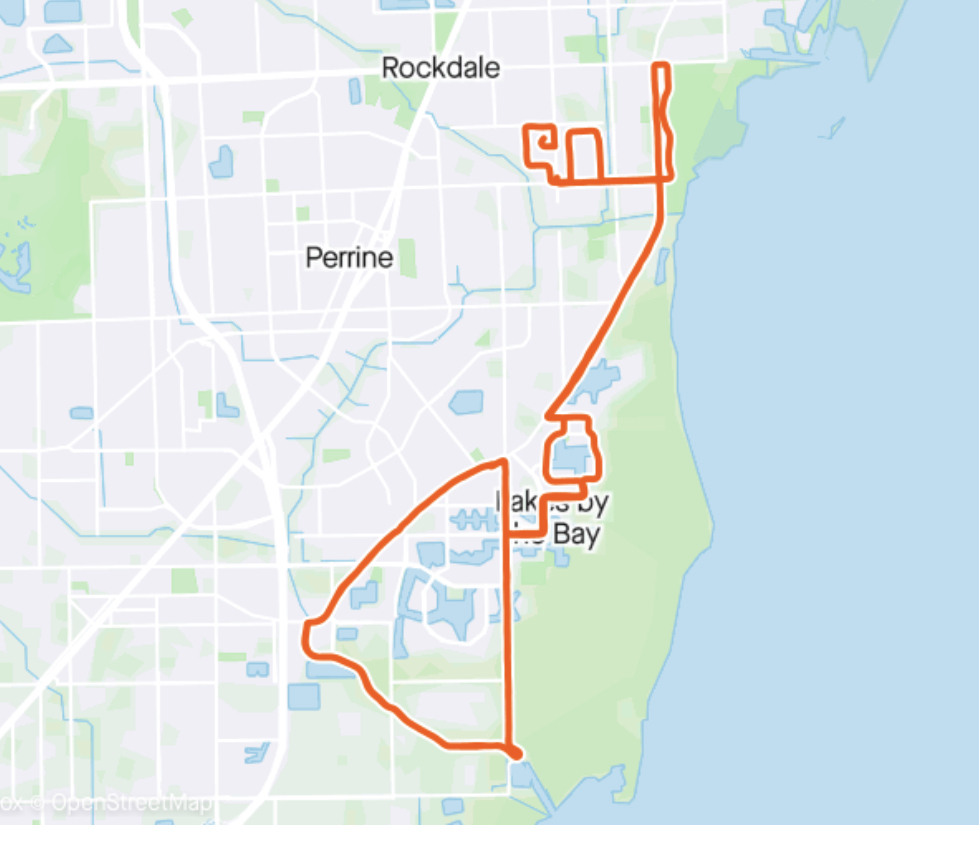
Check out the hundreds of vultures congregating in and near the southern Mount Trashmore on this Sunday chill ride - 31 miles for the day. 106 Miles for the week. 3,812 miles for the year to date.

I am working to complete my annual goal of 4,000 miles.
The Strava segment known as "Vulture Alley"


Thursday, November 18, 2021

Nov 18, 2021 Update to POD of 9/20/2021. Non-native grass planted, appears to be no requirement to replace the lost canopy. More trees lost to the ax.


The tree loss extends beyond the SW 136th Street MEGA sidewalk project. 82nd avenue is joining the streets undergoing tree diets.  It now appears as if no trees ever stood on the Northeast corner of SW 152 Street and 82nd Avenue. But there were - the Oaks were at least 50 years old. They survive many storms, including Hurricane Andrew in 1992, but they could not survive the chain saw. 

I posted the question on 9/20/2021: when will these oaks be replaced? How many others have been removed in Palmetto Bay? We now have our answer as to replacement: The policy appears to be that lost trees are not being replaced, instead, non-native lawns are being planted where the trees once stood. This is more maintenance; including mowing and fertilizing. Less shade, no replacement of trees.

Palmetto Bay officials appear unconcerned. It is as if they really do not care to remain a Tree City USA community? The pictures speak for themselves. And take note, the big stately Oaks were in the public right of way. They can be, they should be, replaced.

Where is the tree maintenance / replanting program that Palmetto Bay once took pride in? 

Answer? There are new policies at play that reflect the current priorities (or lack of) for this current mayor and council.

For background, see prior related post of Monday, September 20, 2021, POD. Monday, 9/20/2021. Time to grind some stumps and sweep more issues under the rug.

Photos from the prior post documenting what once stood there:

Friday, November 12, 2021

RIP Winter the Bottlenose Dolphin

One of our daughters texted us the bad news over night: Winter the Dolphin, star of 'Dolphin Tale', dies at 16, Bay News 9, by Cait McVey.

Winter captured the hearts of everyone with her story of the heroic efforts to save her life through a prosthetic fin. Winter the Dolphin made headlines national headlines in 2005 when she was rescued off the Florida coast and taken to the Clearwater Marine Aquarium. She was severely injured when she became entangled in a crab trap line. She later went on to star in the 2011 move Dolphin Tale. A very moving movie. This is not the ending that we hope for Winter. 

RIP Winter. 

The official statement from Clearwater Aquarium:

With heavy hearts, Clearwater Marine Aquarium announced tonight that Winter the Dolphin died at approximately 8 p.m. as animal care experts from around the country worked to treat her gastrointestinal abnormality. The CMA family is devastated.

During preparation for a procedure, the CMA Animal Care team observed that Winter’s behavior and vital signs were declining. The medical team tried several life-saving efforts, but she died being held by her caregivers.

“While we are heartbroken by Winter’s death, we are comforted knowing that our team did everything possible to give her the best chance at survival. We worked with specialists and marine mammal experts from around the country to provide her with the best care available. Our staff worked around the clock during this challenging time,” said Veterinarian Dr. Shelly Marquardt, DVM, CVA. “I’m honored to work alongside such dedicated and talented professionals who gave their all for Winter.”

The CMA team expresses our deepest gratitude to the thousands of people from around the world who sent caring messages for Winter. She truly inspired hope and was loved by millions of people worldwide.

Winter, we love you.

CMA will be closed on Friday to provide time for our staff to grieve. A grief counselor will be made available to the team.

Plans for a memorial for Winter, honoring the positive impact she made on the world, will be announced soon.

Red-whiskered Bulbul sighting. It has been a while

Spotted out front of the home. I apologize for not obtaining a photo, but these birds don't wait log and pose for photos. 

The story behind the Red-whiskered Bulbul (Pycnonotus jocosus) Information taken from the online audubon.org field guide (CLICK HERE to view more information)

When a few Red-whiskered Bulbuls escaped from an aviary in the Miami area in 1960, they found an environment perfectly suited to their needs. The climate was not too different from that of eastern India, where they had originated; and the suburb of Kendall, Florida, was heavily planted with exotic trees and shrubs, providing the bulbuls with abundant berries throughout the year. The birds quickly became established, but they have not spread much beyond Kendall. 

Yet another reason to plant food sources in order to attract and enjoy your own backyard oasis.

PRIOR RELATED POSTS:

June 24, 2021, Wildlife photography - pictures give reason to appreciate and therefore the drive to protect our local wildlife - Photos by Jennifer Santino-Finger that aid other local wildlife activists.
March 18, 2021, Videos of the Day. Slowing down to appreciate the little things. 2 videos

March 11, 2020, Just for fun - backyard wildlife entertainment. Squirrel lunchbox.

January 29, 2020, Video of the Day - the sounds of morning in Palmetto Bay. Birds are singing and squirrels are barking

March 22, 2019, Bees plan on working through the weekend. Our Dombeya Seminole plant is "abuzz". POD

June 20, 2015, Photos of the Day - Mainland Marsh Rabbit

April 19, 2015, Earth Week - the events have begun in Palmetto Bay! Join us. Photos of the day - Bird Watching Workshop

April 2, 2012, A must read: Miami Herald’s "The wildlife is in the backyard". I would suggest a friendly competition / coordination between the sister cities to surpass Broward County in creating more backyard retreats

Thursday, September 30, 2021

"Missed message": Ignoring Cortada’s message as the current mayor once again misses the importance of going native – a Wildflower Meadow could have been planted, but we get – instead - another wasteful grass lawn

Pallets of sod on 136 Street
What a wasted opportunity! And this is what happens when you leave out creative minds and input from those concerned with the environment.

Truly a missed opportunity. Palmetto Bay could have — no, should have —planted for pollinators and established a Wildflower Meadow habitat for our local birds, bees and butterflies. But this takes thought, and concern for our environment. Once again, this project was never brought out for a public discussion. No public disclosure of the alleged landscaping plan.

Instead, sod was delivered to the SW 136th Street MEGA sidewalk Shared Path project on Wed. 9/29/2021. Please tell me that this is a joke, that SW 136 street is not actually receiving a planting of non-native grass as the replanting of greenspace lost to the MEGA sidewalk. 

This is not an environmentally friendly landscaping plan. Instead, it is a waste of lawn that will require fertilizer and watering - something that a village should avoid if it truly wants to be green. 

Instead, this mayor and council missed the message put out by the recent art piece installed by local artist Xavier Cortada - the message of Cortada's  "Flower Force" public art sculpture should have inspired this mayor and council to follow the LEED /sustainability statement and plant native Coreopsis wildflowers (the official State of Florida wildflower) rather than a high maintenance lawn. The native coreopsis wildflower is a Florida native. It is no maintenance and drought tolerant.

What a loss. A Wildflower Meadow might have improved this bland cement mega sidewalk. Seriously, what would have looked nicer, a Wildflower Meadow or grass? Another opportunity to improve our native environment is lost. We could have involved our local students in a planting project. Bringing volunteerism back to Palmetto Bay and continued to develop a sense of environmental steward ship, but instead, opportunity lost.

A wildflower meadow may have really tied SW 13th Street together.
It certainly would have been nicer than plain high maintenance St. Augustine lawn!

Oh, and just an aside, small landscaping trees are currently being planted. I have two observations here: First that these trees are small, not making up for the canopy of the mature trees lost to the cementing of SW 136 Street. Secondly, these trees are being planted on the Pinecrest side.

Yes, that's right, Pinecrest gets more trees and green while Palmetto Bay gets cemented over.

But then again, this mayor and council proceeded on this project on their own without public input or input from the Tree Board or Palmetto Bay Garden Club. The Palmetto Bay Garden Club would have been an excellent resource both for sustainability as well as creativity. 

Tuesday, September 28, 2021

Update on the Coral Reef Park trees. New ones planted. Look how far from the asphalt.

The new trees are far from replenishing the lost canopy as they will take 20-40 years to catch up to the ones lost to the ill-conceived bridge installation, but we will have to settle for what we can get from this current council. 
FAIR QUESTION: I have a question for those who mocked the warnings made in concern for those now lost trees: Why are these trees (thankfully) planted so far from the newly pour asphalt, far from the increased elevation? 
The question above was rhetorical as clearly the path was not healthy for the trees. It killed them and the trees became a feast for Ambrosia Beetles, which are primarily known to attack weakened, dying, and recently cut or killed trees - nature's dead wood clean up crew.  Look how far these trees were planted from the asphalt. It is my opinion that this is a clear admission that Palmetto Bay officials killed the trees and are not being responsible stewards of our environment.

Another comment: 1:1 replanting is insufficient. The canopy is not replaced. The replanting should be better than a 3:1 replacement to make up for what they Village squandered. Remember that more has been lost than just these 2 trees. There are 2 more Oaks cut down in the right of way at 82nd and Coral Reef Drive. And then there are the many, many trees being stripped from SW 136th Street for the MEGA sidewalk.
The scar that currently remains in the bridge path.

Ask yourself: Why wasn't a tree re-planted where a beautiful 40 plus year old oak once stood? Because it would have only a slightly better change of survival (the original had no chance).

THE TOOL BOX -  some prior related posts:

Monday, September 20, 2021

POD. Monday, 9/20/2021. Time to grind some stumps and sweep more issues under the rug

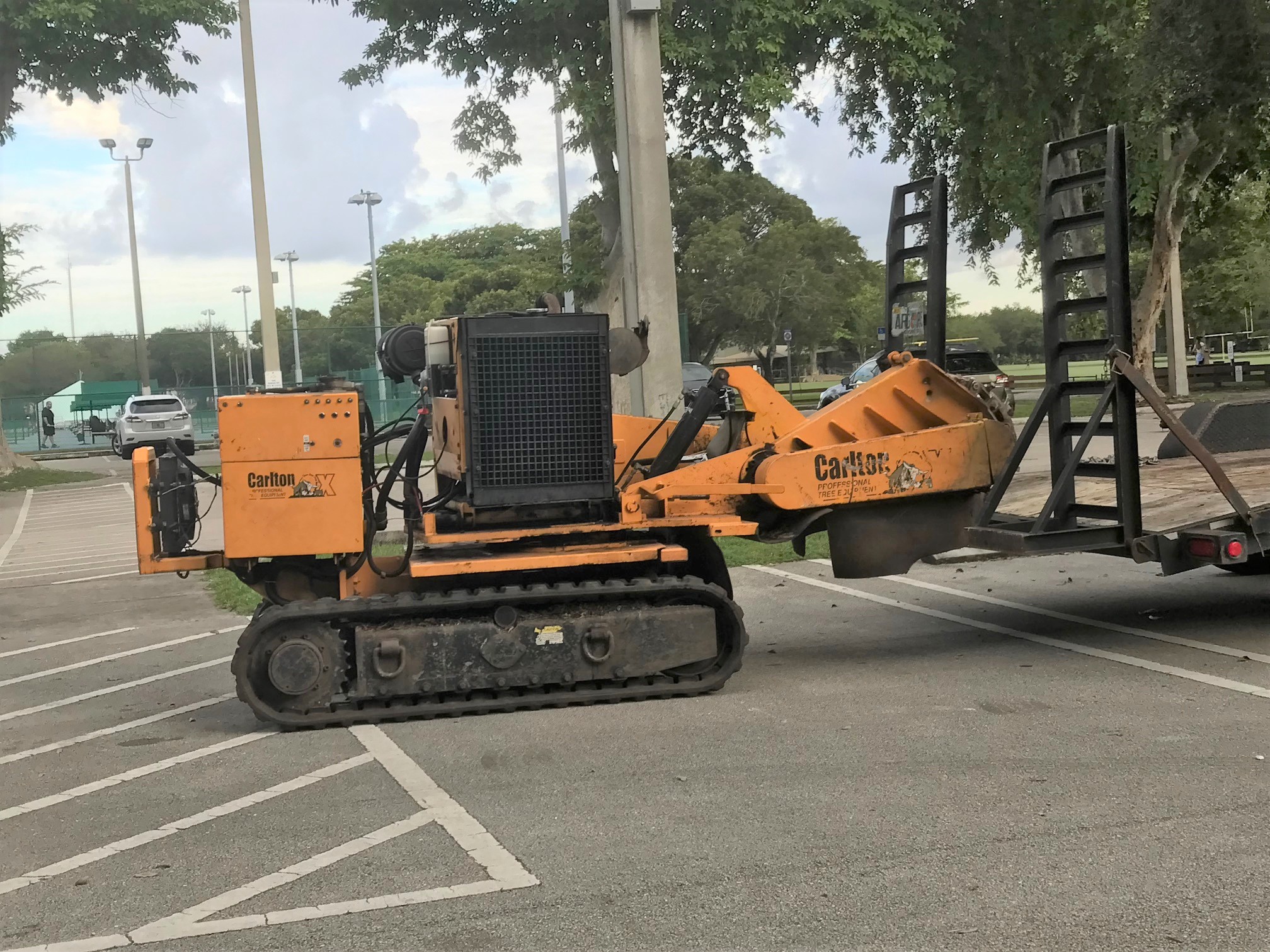
A friend of South Dade Updates (FOSDU) sent me photos taken at Coral Reef Park this morning.

A stump grinder is parked and ready to finish off the last remnants of those two original oak trees at Coral Reef Park

Inside baseball joke of the day: I wonder if the current mayor and council have their stump speech ready for this situation? They certainly have not been keeping us in the loop regarding the sad state of the war on trees currently going on in Palmetto Bay. 


BUT WAIT, THERE'S MORE: Since they have the stump grinder at the ready, can we expect that the grinder will move from Coral Reef Park to the nearby 82nd Avenue at Coral Reef Drive? There have been two oak stumps that appear to represent a hazard as they are in the right of way and are only marked (at times) by an orange cone. Photos of the current status as well as the trees, pre cutting, are posted below for your reference.
Above, Current state of the stumps.
Below, many of us remember how these oat trees once looked.

FAIR QUESTION: When will these oaks be replaced? 4 mature oaks are documented in just this one blog post. How many others have been removed in Palmetto Bay?

THE TOOL BOXCLICK HERE to view a 2016 presentation of the (then) Palmetto Bay Council urban forestry and tree addition initiatives 

Sunday, September 12, 2021

Why? These trees once thrived in Coral Reef Park. That is until this current mayor and council started their war on trees in Palmetto Bay

Coral Reef Park - losing beautiful specimen oak trees. These trees had thrived in Coral Reef Park for over 40 years. That is until this current administration took over and demonstrated their preference for asphalt and concrete. Take a look at Coral Reef Park to see how many new paths have been paved over grass. The paving of green space. But it is not just Coral Reef Park. The Palmetto Bay designed 8-10 foot shared path is yet another example of concrete over green.

These photos bring reality and mock the current administration's use of #PalmettoBayProud. Are you? Are they really?

Enough comments. Here are the photos of the day - a small series of photos sent to me by a fellow concerned resident. So many fellow residents are just floored as to how this current administration seems to have little concern for the trees.  I want to thank everyone who has reached out. 


I can't decide what stands out more: The two dead trees (any green is from the healthy trees behind the front two) or all that railing that now divides part of the part and has become a visual focus of the East side of the Park. The bridge has brought us more than 2 (for now) dead trees. It also has fenced off anyone from walking along the canal bank. I have yet to hear anyone tell me how all this railing adds beauty to the park.


Could this issue have been avoided if Palmetto Bay had gone through the proper process in pulling a permit?  See March 5, 2020, Palmetto Bay officials – acting as if “permits are for the little guy”: building a bridge without a permit – caught, now on hold, waiting for the permit. WTH (heck)??? Follow up on the issues.

Who designed and determined where to place this new bridge? The design required a significant ramp (also requiring a hard turn, further demonstrating how this current mayor and council shoehorned this bridge project into the park). Both trees had up to 4 feet of earth pushed up around their trunks. Frankly I can't believe the members of Palmetto Bay's Tree Board approved this - or sat quietly once the plans were presented. Where were they? Missing in action.

The current mayor and council succeeded if their goal was to clear the shade from parts of the Coral Reef Park paths as well as the SW 136st Street shared path. I wonder if the dead trees will  be removed from the park, or if they will remain as part of an upcoming Halloween event (scary dead trees) slated for Coral Reef  Park next month. 


The tool box: a link to Prior related Posts:

September 9, 2021, Remember the trees I warned the Village about in April? Well those trees are now dead. Why it matters.

March 5, 2020, Did I touch a nerve? Readers react. Village officials attempt to hide their shame behind a green screen for all to see at our upcoming community picnic. Update of the bridge.

September 9, 2021, Remember the trees I warned the Village about in April? Well those trees are now dead. Why it matters.

April 26, 2021, Poor Tree. Who determined where and how to locate the Coral Reef Park Bridge? Regulations ignored. Once again, Palmetto Bay acts say: do as (Palmetto Bay) says, not as Palmetto Bay does.