Showing posts with label Invasive species. Show all posts

Monday, July 29, 2024

A new exercise opportunity for Coral Reef Park - here now : "The ROCKY II Chicken Chase"


For the fitness buffs - Palmetto Bay is supplying the chickens - all you have to do is chase them!

Also see PRIOR RELATED POST - Monday, July 22, 2024, Coral Reef Park and the Mangowood community have a morning wake up alarm.

I'm told that there are many to choose from - see photos posted below - supplied by readers (Please send more)

Also coming soon - reader submitted photos of Roosters who have come home to roost in other areas of Palmetto Bay (please mail photos to me at eugeneflinn@bellsouth.net)

Wednesday, April 19, 2023

Statement of Eugene Flinn regarding management of wildlife in Coral Reef Park: The truth about the CRP wildlife removal

No Muscovy ducks or Egyptian geese were harmed during any of my three terms as Mayor of Palmetto Bay. This is readily apparent from the receipts for animal removal, which I received from the Village, and which I am attaching. The Village and its council members are well aware that they did not occur during my tenure as mayor, assuming they can read a calendar. 

 For reference, I served on the Palmetto Bay Council from its creation in 2002 until shortly prior to Election Day, 2010. I then took office again in December, 2014 and served until December 4, 2018. I was not in office from November 8, 2010 to December, 2014 or after December 4, 2018. This is when the geese removals took place. 

Removal Receipts During the Stanczyk Administration 

The current Palmetto Manager presented some police and injury reports at the April 17 Council meeting, alleging that the Egyptian Geese (not Muscovy Ducks) were responsible for aggressive behavior. Apparently there were also attorneys who wrote at least one demand letter (I do not know if any suit was filed or it was settled pre-suit, if at all). The receipts for removals that were discussed Monday, April 17, which appeared to cover the following dates: 11-17-2010, 1-03-2011, 4-11-2011, 11-1-2013, 12-5-2013, 1-3-2014 and 4-15-2014 (for service dates of 1-24-14 & 4-16-2014). 

I have undertaken additional research; trying to find the receipts for these alleged trappers. I have itemized the receipts below. The earliest was 11-17-2010 - that removal occurred after my last meeting as Mayor of Palmetto Bay (Second Term). Shelley Stanczyk was sworn in as mayor at the following meeting. She also sat on the council next to me from 2006 – 2010 and served as mayor from 2010 to December 2014. The next receipt was dated April 11, 2011, followed by 11/1/13, 12/5/13, 1/3/2014 and 4/15/2014. 

None of these removals were for Muscovy Ducks. All were for the Egyptian Geese. All but one were during times when I was not in office. I will explain further about removals during my time in office. 

The Only Removals During the Flinn Administration Were Humane Removals/Relocations 

As stated previously, I was not in office from November 2010 through December 2014. 

Back to my first two terms, I was involved in one wildlife re-location with Todd Hardwick; but that was removing Wally the gator from the Perrine Wayside Park (Current Dog Park). I was assured that the gator was to be relocated (and he did qualify for relocation due to his or her size). That capture was featured on Animal Planet, the episode airing in January 2005. It was interesting that I was not made aware of the capture in advance. I was advised by a Miami Herald reporter (pictured above left) who advised me just before it happened. As you can see, I was dressed for court, not gator capture. But I did end up with a story for the hearing which was delayed so I could ensure that the gator was not harmed! 

 I did find a reference of an opossum removal at Coral Reef Park dated 12-11-2009. I was mayor at that time. I do not ever recall being advised of any opossum removal. I would love to hear what it did wrong. Possums are good guys. Perhaps the removal was more to remove a sick or an injured possum or to get it out of a vent or closet rather than a vicious possum running amuck in the park. Regardless, it was not part of an ongoing mission to eradicate opossums. 

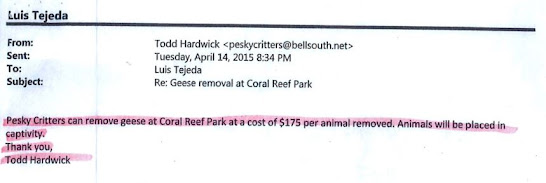
I returned to office (Term 3) in December of 2014. Geese were removed at CRP park, but it ended in 2015. Again, I am looking for the reports/documentation relating to parks. Please note the difference in removal that occurred during my Third Term as noted in email of 4-14-2015 from Todd Hardwick of Pesky Critters to CRP Manager Luis Tejeda: 
Pesky Critters can remove geese at Coral Reef Park at a cost of $175 per animal removed. Animals will be placed in captivity
Thank you, 
Todd Hardwick 
(Bold emphasis added) 

I take Todd Hardwick at his word. These animals were not slaughtered. To the contrary, they were placed in captivity. 

The removals stopped cold in 2015 – that is until July 29, 2021, as indicated on the village supplied receipts. The Village has not documented any Muscovy duck removals occurring until recently, at least 3 years after my third term ended. 

But there is more. What concerns me is an 11-19-2021 removal of a fox at Coral Reef Park. What did the fox do? It was probably trying to make a go of it in the 5 acre nature preserve at the park - a place where native animals (such as foxes) should have sanctuary. And, by the way, foxes are predators of Muscovy ducks. Both the ducks and the eggs. Perhaps removal of the fox upset a natural balance going on at the park, keeping the duck population manageable - I cannot recall any complaints from 2015 to November 2018 when I last held office. 

Receipts (provided through the Village of Palmetto Bay) (attached): 
11-17-2010     $ 750.00     10 Geese         Pesky Critters 
04-11-2011     $ 675.00     12 Geese         Pesky Critters 
11-01-2013     $ 572.00      7 Geese         Miami Animal Removal 
12-05-2013     $ 218.00     Swan Goose       Miami Animal Removal 
01-03-2014     $ 236.00     10 Geese         Miami Animal Removal 
04-15-2014     $ 413.00      7 Geese         Miami Animal Removal 
04-15-2015     $ 525.00      3 Geese         Pesky Critters 
04-24-2015     $2,275.00    13 Geese         Pesky Critters – 
                                             SPECIAL NOTE see email 
                                             of 4-14-2015 

SPECIAL NOTE email of 4-14-2015 from Todd Hardwick of Pesky Critters to CRP Manager Luis Tejeda: 
Pesky Critters can remove geese at Coral Reef Park at a cost of $175 per animal removed. Animals will be placed in captivity. 
Thank you, 
Todd Hardwick
(Bold emphasis added) 
Don't leave out this 2021 removal:

07-21-2021     $ 350.00      2 Geese         Pesky Critters 

Please note the difference through price and ultimate resolution regarding the wildlife: 

$ 175.00 for Pesky Critters – the geese were humanely removed and placed into captivity 
$   45.00 for current trappers of Muscovy Ducks – slaughtered and photos of dead ducks circulated. 

Also see the records I pulled from the Palmetto Bay check register. (pictured below)
I am available to answer any follow-up questions regarding this at (305) 302-3713. However, my blanket statement is that any statement that ducks or geese were removed and killed during my terms of office is a slanderous falsehood, as the receipts clearly show this was not the case. 

This is not a political issue. The issue is how our wildlife is treated in Palmetto Bay.

Thursday, July 29, 2021

Introducing the Caecilians, a newly discovered non-native species to our South Florida environment.

Yet another non-native appears to be settling into South Florida ecosystem. There are reports of a very strange, ‘noodle-shaped amphibian’ known as “caecilians”  (pronounced “Sicilians”) having been found in the Tamiami Canal. South Florida appears to be the area in the United States where this animal has been documented, according to a new report from the Florida Museum of Natural History in Gainesville and as reported in the Miami Herald. It was reported by the Miami Herald that the Florida Fish and Wildlife Conservation Commission (FWC) officers recently came upon this specimen about a mile south of Miami International Airport.  According to the Herald, The aquatic, limbless, worm-like animals belong to an ancient order of amphibians that has been around since even before the dinosaurs.

Information below is taken from Florida Museum online, Weird, noodle-shaped amphibians known as caecilians found in South Florida canal, by Natalie van Hoose, July 28, 2021:

Caecilians have arrived in Miami. Florida Fish and Wildlife biologists captured one of the obscure legless amphibians in the Tamiami Canal, the first example of an introduced caecilian in the U.S.

Florida Museum of Natural History scientists used DNA testing to identify the specimen as the Rio Cauca caecilian, Typhlonectes natans, a native of Colombia and Venezuela. While caecilians – pronounced like “Sicilians” – hunt and scavenge various kinds of small animals, museum experts say it’s too early to predict their potential impact on the local ecosystem.

“Very little is known about these animals in the wild, but there’s nothing particularly dangerous about them, and they don’t appear to be serious predators,” said Coleman Sheehy, Florida Museum’s herpetology collection manager. “They’ll probably eat small animals and get eaten by larger ones. This could be just another non-native species in the South Florida mix.”

Editor's comment: Regardless of its impact, I am sure it is another non-native that we can do without. 

I invite you to read the entire article. Links provided above and below.

The Miami Herald has also covered this discovery, article available to Miami Herald subscribers (paywall): Welcome to Miami? A weird-looking, noodle-shaped animal was just found in a canal, by Madeleine Marr, JULY 28, 2021 

Photo credit – photo from the Florida Museum article only, original credit, “photo courtesy of Noah Mueller”

Thursday, October 8, 2020

From SFWMD News, News Release: SFWMD, FWC Hunters Remove Record Breaking Invasive Python from the Everglades


CLICK HERE to view the SFWMD release online .

Python removal agents working for the Florida Fish and Wildlife Conservation Commission (FWC) and the South Florida Water Management District (SFWMD) recently broke the record for the longest Burmese python eliminated in Florida.

Working together as part of the joint python elimination program under the direction of Florida Governor Ron DeSantis, Ryan Ausburn and Kevin Pavlidis removed the 18 foot, 9 inch snake on Oct. 2 along the L-28 Tieback Canal about 35 miles west of Miami. This beats the state's previous record of 18 feet, 8 inches from 2013.

So far, hunters for the expanded program run by the two agencies have removed more than 5,000 invasive pythons from South Florida’s Everglades ecosystem.

“Under Governor DeSantis, the South Florida Water Management District and Florida Fish and Wildlife Conservation Commission expanded our python removal efforts. Today's record breaking capture shows that our increased efforts are working to get harmful pythons out of the precious Everglades ecosystem,” said SFWMD Governing Board Member “Alligator Ron” Bergeron. "Together with our partners and the public's help, we can restore the Everglades and combat the harmful pythons that hurt Florida’s native wildlife."

“The removal of this behemoth Burmese python is a triumph for our native wildlife and habitats,” said FWC Commissioner Rodney Barreto. “It’s a great example of the partnership between the FWC and the South Florida Water Management District, working under the leadership of Gov. Ron DeSantis, toward our goal of removing these nonnative predators.”

The public can help control nonnative invasive wildlife by reporting sightings to the FWC’s Exotic Species Hotline at 888-IveGot1 (888-483-4681), online at IveGot1.org or by using the free smartphone app IVEGOT1. If possible, take a picture and note the exact location of the sighting. Python Action Team and Python Elimination Program members respond to reports of large constrictors and other priority species to remove these harmful invaders from the wild.

Burmese pythons became established in Florida as a result of escaped or released pets. It is illegal to release nonnative species into the wild and can negatively impact Florida’s native wildlife and habitat. Don’t let it loose! The FWC’s Exotic Pet Amnesty Program allows pet owners to surrender nonnative or exotic pets without penalty. Visit MyFWC.com/PetAmnesty for more information.

To learn more about the FWC’s Python Action Team and the SFWMD’s Python Elimination Program, visit MyFWC.com/Python and SFWMD.gov/Python.

PRIOR RELATED POSTS - CLICK HERE to view prior SDU posts related to invasive snakes, both in Palmetto Bay as well as Miami-Dade County in general. 


Sunday, May 17, 2020

Is there any place in Miami-Dade County not infested with invasive non-native species?

I am seeing these invasive Agamas everywhere. I first noticed them along the South Dade bike trail. This guy is making a home in Westchester.

Wednesday, February 26, 2020

Red-Tailed Boa encounter at Deering Preserve. Attempt made to catch and remove in order to protect our native habitat. Video and links to more information

I have been provided a video taken on Sunday, February 23, 2020, of area residents making a great attempt to remove an invasive red tail boa from the Deering Estate Preserve.

My first comment for those involved: "Great eyes!" You can see from the video just how effective this snake is at camouflage. They were really observant.

Video credit goes to Jeff Frette who both took the video (great work) as well as allowing me to share here on this blog. He advised that Rich McAlpin spotted the snake and called FWC. Jeff called someone who then called a professional snake catcher.  

The snake catcher called turned out to be Kristian Hernandez who won the Python catching tournament.  (See CBS4, January 26, 2020, Winners Of 2020 Python Bowl Showered In Prizes - hhttps://miami.cbslocal.com/2020/01/26/2020-python-bowl-winners/

Unfortunately for native wildlife, Kristian was 10 minutes too late. This was one lucky Red-Tailed Boa who got away to hunt native wildlife another day. May it not be so lucky next time. Eyes are out there, looking out for our native wildlife and engaged in the effort against invasive species.


MORE INFORMATION: I am posting a link to the official FWC Site relating to this invasive species. See: Florida Fish and Wildlife Conservation Commission - Red-tailed Boa

Red-Tailed Boas do represent a significant threat to natives as they feed on lizards, birds, and mammals both on the ground and in trees. Established populations could potentially impact local populations of some vertebrate species. Anyone seen a spotted skunk in the area lately?

This is my 32nd blog post relating to Invasive Species. For similar encounters, see the prior post of December 27, 2015, Send me your python experiences - I am looking to uncover the extent of the population - and REPORT any sightings.

Thank you to Jeff Frette and Rich McAlpin for stepping in, making the call, seeing this through and most of all, watching out for our local nature.

Saturday, January 25, 2020

Python update. SFWMD announcement: Participants in the Florida Python Challenge™ 2020 Python Bowl removed 80 invasive Burmese pythons from the Everglades while simultaneously helping to raise awareness about this important conservation issue

Pythons are just one of the numerous threats that impacts the Palmetto Bay / Cutler Bay area along with South Florida / the Everglades. Pythons and other invasive non-native constrictors have been killed and captured here in Palmetto Bay. (CLICK HERE) to view some of these prior posts. This is my 31st post regarding Invasive Species

The results are in for the  2020 Python Bowl!

The South Florida Water Management District (SFWMD) put out a News Release on Jan. 25, 2020, providing an update that 80 pythons submitted during the 2020 Python Bowl! Noting that the "Competition to remove invasive pythons from Florida’s Everglades is a big success."

Click the link above (or CLICK HERE) to view this full release.

Participants in the Florida Python Challenge™ 2020 Python Bowl removed 80 invasive Burmese pythons from the Everglades while simultaneously helping to raise awareness about this important conservation issue. Today the Florida Fish and Wildlife Conservation Commission (FWC) and the South Florida Water Management District announced the results and winners of the Python Removal Competition at the 2020 Python Bowl award ceremony at the Super Bowl Live event in Miami.
Here are the official Florida Python Challenge™ 2020 Python Bowl results:Most Pythons
  • Pro grand prize winner Mike Kimmel won a TRACKER 570 Off Road ATV for removing eight pythons.
  • Rookie grand prize winner Kristian Hernandez won a TRACKER 570 Off Road ATV for removing six pythons.
  • Pro second prize winner Lindsey Floyd won $750 for removing six pythons.
  • Rookie second prize winner Ethan O’Neil won $750 for removing four pythons.
  • Active service member or veteran winner Barry Offenburger (U.S. Army) won $1,000 for removing three pythons.
Longest Python
  • Pro grand prize winner Tom Rahill won $2,000 for a 12-foot, 7.3-inch
  • Rookie grand prize winner Kristian Hernandez won $2,000 for an 11-foot, 6.5-inch python.
  • Pro second prize winner Amy Siewe won $750 for a 10-foot, 7-inch python.
  • Rookie second prize winner Dave Mucci won $750 for an 11-foot, .08-inch python.
  • Active service member or veteran winner Dave Mucci (U.S. Air Force) won $1,000 for an 11-foot, .08-inch python.
Heaviest Python
  • Pro grand prize winner Tom Rahill won $2,000 for a 62-pound python.
  • Rookie grand prize winner Dave Mucci won $2,000 for a 49.4-pound python.
  • Pro second prize winner Dustin Crum won $750 for a 9-pound python.
  • Rookie second prize winner Kristian Hernandez won $750 for a 1-pound python.
  • Active service member or veteran winner Dave Mucci (U.S. Air Force) won $1,000 for a 49.4-pound python.
More than 750 people from 20 states registered to take part in the 10-day competition to remove Burmese pythons, which are decimating native wildlife populations in the Everglades. Everyone who registered passed a mandatory online training. Another 550 people took part in hands-on, optional safe-capture trainings that taught them how to identify, locate, and safely and humanely capture Burmese pythons. 
“The Miami Super Bowl Host Committee is very proud to have worked with these partners to bring attention to the threat that invasive species pose to The Everglades,” said Rodney Barreto, Chairman of the Miami Super Bowl Host Committee. “There are many men and women who work diligently every day to combat the harmful impacts of nonnative species and it is imperative that we are all educated on the effects of the Burmese pythons to our native wildlife.” 
“Having more than 550 people come out to take part in optional in-person trainings is a testament to the public’s commitment to helping conserve Florida’s precious natural resources,” said FWC Executive Director Eric Sutton. “Public support is critical as is the strong leadership of Gov. DeSantis and the support of our partners and sponsors including the South Florida Water Management District, the Miami Super Bowl Host Committee, the University of Florida, Bass Pro Shops and the Bergeron Everglades Museum and Wildlife Foundation.” 
“More than 750 registrants joined Florida’s ramped-up efforts to remove harmful pythons from America’s Everglades as part of the Florida Python Challenge™ 2020 Python Bowl,” said South Florida Water Management District Executive Director Drew Bartlett. “The national and international attention around Super Bowl LIV brought incredible public awareness to the danger invasive Burmese pythons pose and the importance of Everglades restoration. Congratulations to all the winners, and a big thank you to Gov. DeSantis, the Florida Fish and Wildlife Conservation Commission, the Miami Super Bowl Host Committee and everyone who participated in this important conservation effort.
In addition to the Python Challenge™, there are several ways the general public can continue to help control nonnative species such as Burmese pythons. Anyone can hunt pythons any time on private lands with landowner permission and on 22 public lands throughout south Florida. People can also take part in ongoing Python Patrol trainings to learn more about how to identify and capture Burmese pythons in the wild.  Learn more at MyFWC.com/Python. 
The public can also help control invasive species by reporting nonnative fish and wildlife to the FWC’s Invasive Species Hotline at 888-IVE-GOT1 (888-483-4681), by reporting sightings online at IveGot1.org or by downloading the IveGot1 smartphone app.
EDITOR'S NOTE: Sadly, I did not take part this year, perhaps I will have an opportunity in the 2021 challenge. Also see:  May 25, 2018, 1,000 fewer pythons in the Everglades. Miami Herald Reports. I was part of one out of the 1,000.
Photo taken 2-18-2018 - photo from sanctioned/licensed hunt effort,
but not related to 2020 Python Bowl


Sunday, November 3, 2019

Reports of removal of invasive species - in this case Iguanas. How should it be done? Link to a video and the FWC guidelines on removing the invasive iguana

Another in my opinion series. What are your thoughts? The reason I raise this issue relates to sudden reports here in Palmetto Bay residents who have witnessed various animals being caught, killed and removed here in Palmetto Bay. Are any Village Officials monitoring this? Is Village leadership even aware of these 'hunts' and, if so, what is the plan? Or is this one of those 'fail to see, fail to act' situations?

I have embedded a video that the photographer asserts to be of people on the canal killing iguanas. The videographer acknowledges that Iguanas are considered to be a nuisance, but thinks they should be killed humanely, and questions if the method in the video is humane. These guys are snagging the iguanas with a snare, and then shooting them with a pellet gun.  In this video, you can see at least 3 shots to one iguana.  I doubt it is dead at this point. 

The allegation is that these hunters are being paid $50 per iguana from the gated community to the south of the videographer.  (I am withholding the location of the HOA at least at this time).

The Videographer has issues imagining this would be considered humane. Don't get me wrong, these Iguanas are invasive. They are damaging our native areas. The issue is proper methods, humane methods and using licensed removers. Are they? I don't know. That is why I am putting this out there to stimulate debate and awareness.  As stated by FWC Commissioner Rodney Barreto: "...(They - FWC) are asking the public to just go out there and shoot them up. This is not what we are about; this is not the ‘wild west.’ If you are not capable of safely removing iguanas from your property, please seek assistance from professionals who do this for a living..."

What is your opinion of this method of Iguana removal?


Note – It is legal to kill Iguanas - Property owners are free to humanely kill the iguanas, or trap them and bring them in to a veterinarian or humane society for euthanasia. It is illegal to poison the creatures. Iguanas, like all nonnative, invasive species, are not protected in Florida except by anti-cruelty law.

CLICK HERE to view the official FWC site relating to the Invasive Green Iguana (Iguana iguana)  Information below taken verbatim from the FWC Website:
Frequently Asked Questions Can I remove iguanas from my property? Green iguanas are not protected in Florida except by anti-cruelty laws and can be humanely killed on private property year-round with landowner permission. The FWC encourages removal of green iguanas from private properties by landowners. Members of the public may also remove and kill iguanas from 22 FWC managed public lands without a license or permit under Executive Order 17-11. Captured iguanas cannot be relocated and released at other locations in Florida. Homeowners that trap iguanas on their property may be able to obtain euthanasia services from local exotic veterinarians, humane societies or animal control offices depending on the location and availability of services. If you are not capable of safely removing iguanas from your property, please seek assistance from a professional nuisance wildlife trapper.
CLICK HERE to view prior related posts of Invasive Species in our community. This is my 30th post relating to invasive species.

HOWEVER! Read the FWC statement (CLICK HERE):
Green iguanas are an invasive species in Florida and are not native to our state. They can cause considerable damage to infrastructure, including seawalls and sidewalks. Iguanas, like all nonnative, invasive species, are not protected in Florida except by anti-cruelty law. While they cannot be relocated, they can be removed from private property with landowner permission.
“Unfortunately, the message has been conveyed that we are asking the public to just go out there and shoot them up. This is not what we are about; this is not the ‘wild west.’ If you are not capable of safely removing iguanas from your property, please seek assistance from professionals who do this for a living,” said FWC Commissioner Rodney Barreto.

Sunday, August 11, 2019

POD - more Everglades nature calling Palmetto Bay home - look at what is also found in these photos; with what the Anhinga is sharing the canal bank.

Photos of the Day.  Another example of local wildlife making a go of it here in Palmetto Bay.  Photos taken Sunday, August 11, 2019 - an Anhinga, an iconic bird of the Florida Everglades - seen drying its wings at the C100 canal in Palmetto Bay near Coral Reef Park.

Now one unfortunate fact that I have highlighted in the photos.   ... a tale of two species: 

The native Anhinga is sharing the canal bank with the non-native / invasive green iguana. CLICK HERE to read the FWC page on the invasive green iguana.
"Green iguanas can cause damage to residential and commercial landscape vegetation, and are often considered a nuisance by property owners," the FWC wrote. "Some green iguanas cause damage to infrastructure by digging burrows that erode and collapse sidewalks, foundations, seawalls, berms and canal banks." CLICK HERE 
More information about the Anhinga can be found on the National Park Service website - Anhinga: Species Profile.

Photo credit - copyright 2019, Craig Merwitzer, Palmetto Bay, FL, USA
CLICK HERE to view prior blog posts relating to local wildlife.

Photo credit - copyright 2019, Craig Merwitzer, Palmetto Bay, FL, USA


Wednesday, January 23, 2019

Invasive snakes - working to save the Everglades ecosystem one snake at at time. SFWMD is now up to 1,971. That's nearly 2.5 miles of snakes.

SFWMD Python Hunters Nearing 2,000 Snakes Eliminated
District program now utilizing additional technologies to efficiently find and eliminate invasive Burmese pythons
SFWMD's python hunters have now eliminated 1,971 of the invasive snakes on District lands, stretching a combined length of almost 2.5 miles and collectively weighing more than 11.5 tons. ....
The invasive Burmese python, which breeds and multiplies quickly and has no natural predator in the Everglades ecosystem, has decimated native populations of wildlife. The more that can be eliminated, especially females and their eggs, the better chance future generations of native wildlife will have to thrive in the Everglades ecosystem that Floridians have invested billions of dollars to restore.
CLICK HERE to read the January 23, 2019 update from the South Florida Water Management District 

Monday, January 14, 2019

Family/children event at Pinecrest Branch Library, Tues., 1-15-19 - Anole Invasion

Calling all local school green team members! (and others interested in our environment as well as literature).

Local author Marta E. Magellan will be at the Pinecrest branch library at 4 PM, TUESDAY, January 15, presenting her new book Anole Invasion to children ages 6-12. 

Learn about invasive lizards, green anoles.

The Pinecrest Branch Library is located at 5835 SW 111 Street, Pinecrest, 305-668-4571, on the grounds of Pinecrest Gardens off Red Road (SW 57th Avenue).


Saturday, November 10, 2018

Bobcat caught eating invasive iguana in Boynton Beach

Will nature step forward and provide a solution for Palmetto Bay's invasive Iguana problem?

Reported in the Miami Herald, online: Bobcat caught eating invasive iguana in Boynton Beach, by Monique O. Madan, complete article:

A visitor on a wildlife refuge tram tour captured a photo of a bobcat with its prey in its mouth Friday afternoon.

In a photo posted by the Arthur R. Marshall Loxahatchee National Wildlife Refuge in Boynton Beach, a giant, non-native green iguana is seen hanging from the bobcat’s mouth.

“Green iguanas are not native to South Florida, so this bobcat is doing good by preying on a non-native species,” the wildlife refuge posted on Facebook.


Read more here:
Bobcat caught eating invasive iguana in Boynton Beach, by Monique O. Madan

CLICK HERE to view the FWC website and information regarding nonnative reptiles

Friday, May 25, 2018

1,000 fewer pythons in the Everglades. Miami Herald Reports. I was part of one out of the 1,000.

There are snakes, pythons no less, here in Palmetto Bay.  CLICK HERE to view past posts, with photos, of past python encounters in our Village).  

These encounters and captures unfortunately did not count toward the python eradication stats kept by the FWC (CLICK HERE for other posts involving FWC, including our Coyote situation).

The python control has now broken 1,000 pythons.  See the Wednesday, May 23, 2018, article in the Miami Herald  (or online 5/22/2018) Florida's Everglades now have 1,000 fewer pythons, by Jenny Staletovich. 

Pythons are invasive and are devastating our local animal population. I'd like to think that I have been doing my small part, both in education through this blog as well as actually participating in a python "hunt" - I was on a python hunt on Feb 19, 2018 (with a licensed FWC guide/hunter) where we bagged this lil guy - 7 feet, 4 inch python. 
In the interest of full disclosure, this python capture took place on February 18, 2018.  The snake was not harmed as part of the capture. The licensed python hunter took the snake the next day to the FWC location where it was measured, logged and then harvested.  


Wednesday, December 28, 2016

Invasives continue to turn up in strange places - please report them if and when you spot them

Pythons swimming in Florida Bay?!  There appears to be no place safe if South Florida environment to encroachment from invasive species. 

I recently received a report of a 5 foot alligator approaching kayakers in the canal that runs along 84th Street here in Palmetto Bay (a NATIVE Florida species).  They were referred to the South Florida Water Management District where they made the report.  At least that is a native species that we need find a way to live with in peace.  For local gator issues - information on how to live with/report them - see my 6/16/16 posting: "Local Gator? Statewide Nuisance Alligator Program - SNAP. FWC Alligator Management Program".

This post is about the continuing travels of invasive species and how I continue to run into more and more of them in and near Palmetto Bay.  This is my 24th posting under the “Invasive Species” label.

Christmas 2015 involved two python sightings (both dead).  No such sightings in 2016. No reports of python road kill or being pulled from swimming pools in Palmetto Bay. 

I am posting an article posted online on December 27, 2016 – Miami Herald  - Think sharks are scary? There’s a new critter swimming in Biscayne Bay, By Jenny Staletovich.

We cannot ignore the fact that we have our shares of Python captures in Palmetto Bay.  A prior post from three years earlier (Dec 12, 2012), noted that two large pythons had been removed from Palmetto Bay in 2012.  CBS 4 reported on November 26, 2012, that a “very large” python who made its home on a Palmetto Bay lawn was removed by the Miami-Dade Fire Rescue Venom Unit near 180 Street and SW 77 avenue.

But I have not yet received a report of a python swimming in the canal.

The invasive were smaller in 2016.  I posted on my personal Facebook page: "Happy Holidays from the non-native invasive basilisk lizard now making its home in Palmetto Bay" - a Brown Basilisk lizard.  This sighting was at my mother-in-law's near Sadowski.  I had first noticed them at Perrine Wayside back when we were first developing that park into our Dog Park. 

Please report what you see – download the app from the FWC – “IVeGot1” Go to - Florida Fish and Wildlife Conservation Commission and link over to "Wildlife & Habitats"

See something?  Report it – and please keep me up to date on what you see and report.

Sunday, December 27, 2015

Send me your python experiences - I am looking to uncover the extent of the population - and REPORT any sightings

This is in follow up to my Saturday, December 26, 2015. post - No denying it - there is a problem in Palmetto Bay. An 8 - 10 foot Python in Palmetto Bay struck on Old Cutler Road led to the following photo being sent to me:

J. May of Paradise Point provided me with the photo posted above, taken 11/22/15: a native rat snake seen slithering in a tree near a third floor bedroom window (no harm to the native environment).


The full photo (posted left) of the tree-dwelling snake demonstrates how well snakes can camouflage themselves in our native flora. 

This was not the first recorded incident.  October 9 - 2015 - local residents were warned of another non-native snake being seen.  The following was circulated the following day:

(referring to October 9) Last night, one of your neighbors found a snake in the middle of the street in the community.  The snake is 5 - 6 feet in length and is either a Boa Constrictor or a Reticulated Python.  Regardless, the snake has the potential to hurt small dogs and cats.  PLEASE keep your pets on a leash at ALL TIMES and keep your cats indoors, if at all possible.

If anyone sees the snake again, I have been advised by FWC to call the Miami-Dade Fire Rescue Venom Unit immediately, who is supposed to be able to assist us with getting rid of it.  The telephone # I was given is 786-331-4443.

The telephone # for the FWC Regional Office is 561-625-5122.  For more information, visit: http://myfwc.com/contact/nuisance-wildlife/
Here is the photo of that snake:
Please bring any further sightings to the attention of myself as well as proper authorities that I have listed on this blog.

Thank you,

Eugene Flinn, Mayor
 

Saturday, December 26, 2015

No denying it - there is a problem in Palmetto Bay. An 8 - 10 foot Python in Palmetto Bay struck on Old Cutler Road

Another Christmas python.  This photo was taken at approximately 4 AM on Christmas (2015) morning.  The snake was DOA by the time the policing unit arrived on scene.  This is my 22nd posting involving the Invasive Species label.
Photo taken approx 4 AM, Dec 25, 2015, Old Cutler Road


We cannot ignore the fact that we have our shares of Python captures in Palmetto Bay.  A prior post from three years earlier (Dec 12, 2012), noted that two large pythons had been removed from Palmetto Bay in 2012.  CBS 4 reported on November 26, 2012, that a “very large” python who made its home on a Palmetto Bay lawn was removed by the Miami-Dade Fire Rescue Venom Unit near 180 Street and SW 77 avenue.  CLICK HERE to review the online story, Pesky Python Removed From Lawn Of Palmetto Bay Home.

Then there was the Christmas Day (2012) removal of a 13 foot Burmese python occurred from a Palmetto Bay pool.  Long time readers of South Dade Updates may recall the posting of the NBC6 report on 12/26/2012: (CLICK HERE) to view: NBC 6 reports: A 13-foot Burmese python was captured in the swimming pool of a Palmetto Bay home.  The Miami Herald reported that this snake was located and captured at a Palmetto Bay home located off 97th Avenue and SW 183 Street on Christmas Day (the link to the Miami Herald story has expired).

Another famous capture was on October 12, 2005, by one of Palmetto Bay's original policing unit officers, Ofc Randy DiStefano, joined the capture of a non-native python.  This capture is took place on the grounds of the current Palmetto Bay Village Hall. 


These invasive pythons will have an impact on our local native animals and even our domestic pets, dogs and cats.  Please report any sightings of non-native species.   

What can you do?  Are you interested in assisting the FWC in locating these pests?  No one is suggesting that you should go out on a hunt, but here is how you can pass on what you observe if you happen to run into any (information taken from the official FWC web site).

Reporting by phone : You can call the FWC’s Exotic Species Hotline at 888-IVE-GOT1 (888- 483-4681). The hotline is answered part-time by a live operator and has a voicemail system that will prompt you for information about your sighting and your contact information if the operator is unable to answer the call. 

Reporting online : You can use the web form at IveGot1.org External Website to report. The form will prompt you for the information and has a map where you can select the location if you do not have the GPS coordinates.  You will need to create a free account the first time you report a sighting online.  

Sending photographs : If you have trouble attaching photos to the IveGot1 online form or smart phone apps, you can send them to ExoticReports@myfwc.com.  

CLICK HERE to view the complete information regarding downloading the app or how to otherwise assist in the effort posted on the Florida Fish and Wildlife Conservation Commission (FWC) website.

Wednesday, December 2, 2015

2016 Python Challenge

2016 Python Challenge
(CLICK the link above to view the official web page)


2016 Python ChallengeTM
.This coming year, with the help of our partners, the Florida Fish and Wildlife Conservation Commission and the Fish & Wildlife Foundation of Florida are hosting the 2016 Python Challenge™. This month-long invasive species awareness campaign will again include a public competition to remove nonnative Burmese pythons from public lands in Florida. With expanded participating areas, the lands where participants can search for and remove pythons have more than doubled.

Are you up for the Challenge? Register for the Python Removal Competition and compete to see if you can harvest the longest or the most Burmese pythons and win grand prizes of $5,000 in the team category and $3,500 in the individual category.

We are providing frequent hands-on training for people who want to learn more about how
to capture pythons, both before and during the event. The 2016 Python Challenge™ will kick off at the Invasive Species Awareness Festival on Jan. 16, 2016 from 10 a.m. until 4 p.m


Details about trainings, competition rules and registration, prizes and events are posted at PythonChallenge.org.
Captured in Palmetto Bay, October 12, 2005

ONCE AGAIN: The bigger question is will Palmetto Bay be included in the hunt zone? 
Of course not, but we should talk about the fact that we have our shares of Python captures in Palmetto Bay.  A prior post from three years early, Dec 12, 2012), noting that two large pythons have been removed from Palmetto Bay in 2012.  CBS 4 reported on November 26, 2012, that a “very large” python who made its home on a Palmetto Bay lawn was removed by the Miami-Dade Fire Rescue Venom Unit near 180 Street and SW 77 avenue.  CLICK HERE to review the online story, Pesky Python Removed From Lawn Of Palmetto Bay Home.

Then there was the Christmas Day (2012) removal of a 13 foot Burmese python occurred from a Palmetto Bay pool.  Long time readers of South Dade Updates may recall the posting of the NBC6 report on 12/26/2012: (CLICK HERE) to view: NBC 6 reports: A 13-foot Burmese python was captured in the swimming pool of a Palmetto Bay home.  The Miami Herald reported that this snake was located and captured at a Palmetto Bay home located off 97th Avenue and SW 183 Street on Christmas Day (the link to the Miami Herald story has expired).  

Another famous capture was on October 12, 2005, by one of Palmetto Bay's original policing unit officers, Ofc Randy DiStefano, joined the capture of a non-native python.  This capture is took place on the grounds of the current Palmetto Bay Village Hall.   

Will more snakes be identified and captured at this Palmetto Bay village hall location?  Who is going to step up and participate in the Python Challenge, 2016?